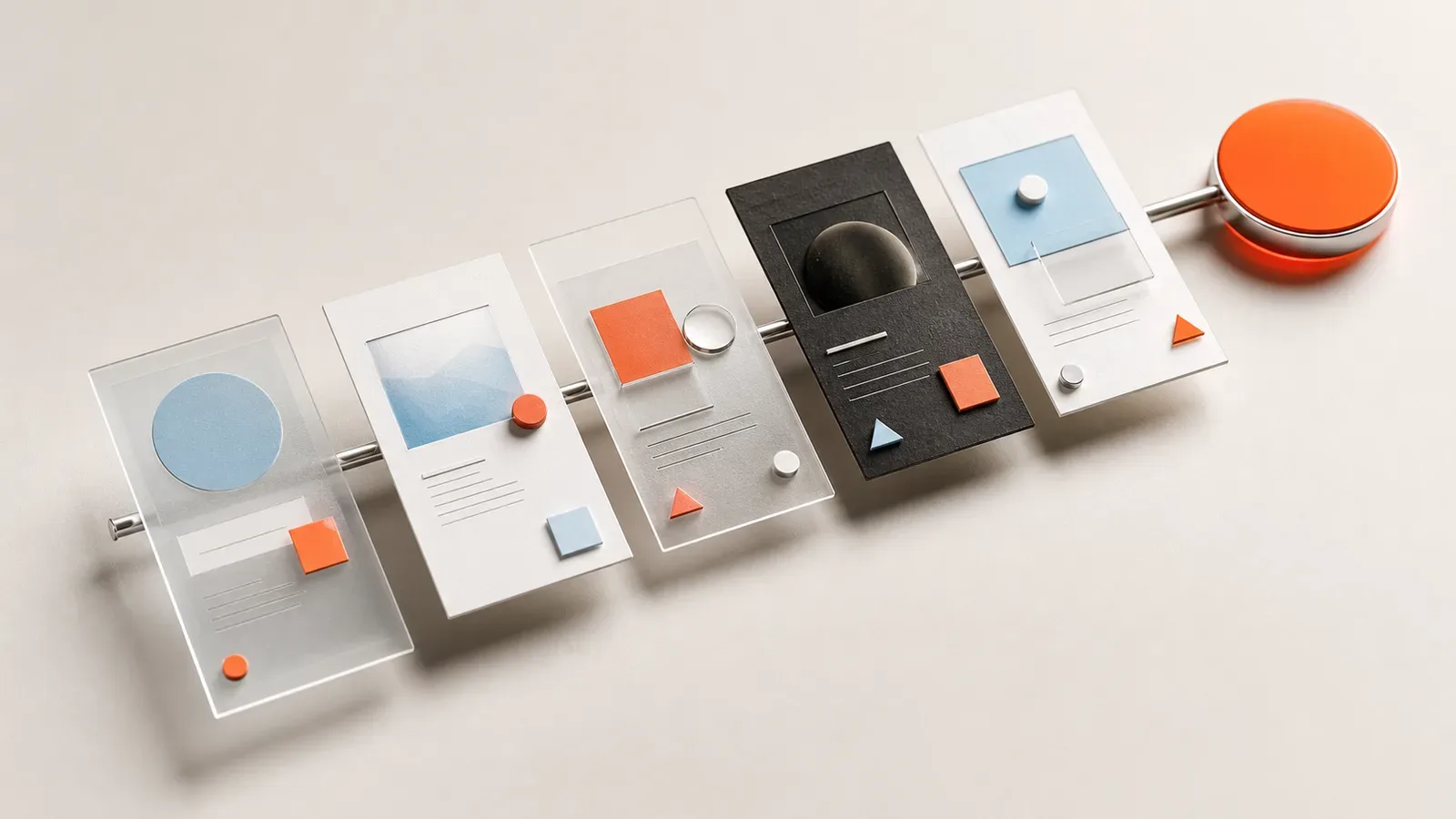
Landing is a one-page website that leads the visitor to one main action: application, purchase, registration or registration for a consultation. It is often chosen to launch a product, a specific service, an event or an advertising campaign.
A small volume does not make the task automatic. A good landing page should quickly explain the offer, remove key doubts and keep the scenario clear on a mobile device. For this, one spectacular cover is not enough.
When a landing page is right for a business
A one-page format is effective if the proposal has a specific audience and one main goal. For example, a company is launching a new service, collecting applications for an event, or testing interest in a product before developing a large platform.
The landing page is also convenient to use for an advertising campaign. The message in the ad can be continued on the page without unnecessary transitions and measure how users get to the form.
The format is suitable when:
- the sentence can be explained sequentially on one page;
- the visitor has one priority action;
- traffic comes from a clear source;
- the product does not require a large catalog or many independent sections;
- the result needs to be launched and measured relatively quickly.
If users need different services, documentation, personal account, catalog and individual information materials, trying to fit everything into a landing page will create an overloaded page. Then it is better to design a multi-page website.
What are the stages of creating a landing page?
1. Define purpose and audience
First, the action that the visitor must perform is formulated. “Meet the company” is too vague. The purpose may be to submit an application, select a tariff, sign up for a demonstration, or proceed to payment.
At the same time, the audience is clarified: what the person already knows about the product, what question he comes with, and what doubts prevent him from making a decision. The order of the arguments depends on this.
2. Gathering facts
Landing pages require more than just advertising language. Specific product characteristics, operating conditions, examples, numbers, reviews, photos of a team or process are useful.
If there is little evidence yet, it is better to honestly show the principle of operation and the boundaries of the proposal than to fill the page with general promises.
3. Scenario and prototype
The information is arranged into a route. Usually the visitor needs to understand:
- What is being offered to him?
- Who is this solution for?
- What problem does it solve?
- Why can the offer be trusted?
- What is included in the result?
- What happens after the application?
Order is not a universal pattern. For a familiar product, the price may appear immediately, but a complex B2B service first needs to explain the approach and demonstrate competencies.
4. Text
The text is designed along with the structure. The title sets the promise of the page, the subtitle clarifies it, and each subsequent block answers a specific question.
It is important to remove phrases that can be placed without changes on the website of any company. “Individual approach” does not explain the difference until it is shown exactly how this approach manifests itself.
5. Visual concept
Design helps guide attention by separating steps, showing hierarchy, and making evidence visible. A strong idea is useful if it supports the character of the product and does not interfere with reading.
At the same stage, the mobile composition is checked. Most advertising traffic may come from the phone, so the form, buttons and key arguments should be easy to use on a small screen.
6. Development
The layout is assembled in the browser, forms, analytics and necessary integrations are connected. Images are optimized and animations are tested for performance and accessibility.
Before launch, request submissions, error messages, link clicks, and analytics events are tested. Otherwise, the page may look ready, but lose hits due to technical details.
What affects timing
The main source of delays is not page length, but uncertainty. If the audience, proposal, and materials are aligned, the work moves forward consistently. If the product changes during design, each new fact may require a rebuild of the script.
The duration is affected by:
- readiness of texts, photographs and facts;
- the number of decision-makers;
- complexity of the visual concept;
- non-standard animation;
- integration with CRM, payment or external services;
- legal requirements for the form and processing of data;
- number of coordination iterations.
A quick launch is possible when the team constrains the first version in advance and makes decisions within an agreed upon time frame.
What does the cost of a landing page consist of?
The cost is determined not by the number of blocks, but by the volume of unique work. A page on a ready-made template and an author’s landing page with research, text, filming and interactive development are different products.
The assessment may include:
- research and design;
- editing or creating text;
- design and adaptive states;
- illustrations, 3D or animation;
- development;
- integration;
- analytics and testing;
- launch and support.
Therefore, when comparing offers, it is important to find out the composition, and not just the total amount. A low price may not take into account texts, mobile design or form connection.
Landing page on the designer or your own development
The constructor is useful for a simple and immediate start. It reduces technical work if the building blocks and capabilities are sufficient.
In-house development gives more control over the visual system, speed and non-standard behavior. It is justified when the landing page is an important part of the brand, needs to be developed or requires atypical integrations.
The tool is selected after the task. The designer itself does not make the page bad, and hand-written code does not guarantee the result.
What to do after launch
A landing page cannot be judged solely on personal impressions. It is necessary to check the quality of traffic, the share of reaching key blocks, submission of the form and further work with applications.
If visitors don’t take action, it could be because of the ad, offer, price, page content, or form. Analytics helps you isolate these problems and improve your landing page in small, verifiable iterations.
Frequently asked questions
Is it possible to guarantee conversion before launch?
No. Conversion depends on the offer, price, traffic source and processing of requests. Before publication, you can build a clear scenario and prepare a measurement, but the real result is shown by the data.
Is it necessary to prepare all the text in advance?
No. It is better to create key messages along with the prototype. But facts about the product, setting, and audience must be available before design begins.
Is it possible to later turn the landing page into a large website?
Yes, if the structure and technical basis provide for it. If development is expected in advance, components and page addresses should be designed with the next stage in mind.